

Investing in the stock market can be rewarding, but market volatility often makes investors nervous. Many people struggle to decide how much money should be invested in equities and how much should remain in debt. This is where SBI Balanced Advantage Fund stands out. It is designed to automatically adjust its equity and debt allocation based on market conditions, helping investors participate in market growth while managing downside risk.
If you’re a beginner looking for a relatively balanced investment option, this review explains everything you need to know about SBI Balanced Advantage Fund.
Current Market Outlook: Why Balanced Investing Matters in 2026
The financial markets have experienced significant volatility over the past few years due to inflation concerns, changing interest rates, geopolitical tensions, and global economic uncertainty. While equity markets continue to offer long-term wealth creation opportunities, sudden corrections can affect investor confidence.
In such an environment, a Balanced Advantage Fund (BAF) becomes an attractive option because it dynamically changes its asset allocation instead of maintaining a fixed equity exposure.
Why a Disciplined Investment Strategy Is Essential for Long-Term Wealth Creation
One of the biggest mistakes investors make is trying to time the market. Many buy when markets are at record highs and panic during corrections.
A disciplined investment approach helps by:
- Reducing emotional investing
- Encouraging long-term wealth creation
- Managing market volatility
- Maintaining proper asset allocation
- Improving investment consistency
A monthly SIP combined with a Balanced Advantage Fund can help investors stay invested through different market cycles.
What Is SBI Balanced Advantage Fund?
SBI Balanced Advantage Fund is an open-ended dynamic asset allocation mutual fund managed by SBI Mutual Fund. The fund actively shifts investments between equities, debt securities, and arbitrage opportunities depending on market valuations.
Unlike traditional hybrid funds that maintain a fixed allocation, this fund changes its exposure based on market opportunities.
Fund Objective
The primary objective is to:
- Generate long-term capital appreciation
- Reduce downside risk
- Provide better risk-adjusted returns
- Manage market volatility through dynamic allocation
Key Features of SBI Balanced Advantage Fund
Key Highlights
| Feature | Details |
|---|---|
| Fund Type | Dynamic Asset Allocation (Balanced Advantage Fund) |
| Investment Style | Equity + Debt + Arbitrage |
| Risk Level | Moderately High |
| Suitable For | Long-term investors |
| Investment Horizon | 3–5 Years or More |
| SIP Available | Yes |
| SWP Available | Yes |
The fund manager dynamically adjusts the equity exposure based on valuation models and market conditions.
How SBI Balanced Advantage Fund vs Traditional Fixed-Income Investments
Traditional fixed-income investments like:
- Fixed Deposits
- Recurring Deposits
- Government Bonds
- Debt Mutual Funds
provide relatively stable returns but generally have limited long-term growth potential.
Historically, Balanced Advantage Funds have aimed to deliver better long-term returns than traditional fixed-income investments by participating in equity market growth while reducing volatility through debt allocation. However, returns are market-linked and are not guaranteed.
For investors seeking inflation-beating returns over the long run, this type of fund may be more suitable than relying solely on fixed-income products.
How the Fund Helps Limit Downside Risk During Market Volatility
One of the strongest features of SBI Balanced Advantage Fund is its ability to limit downside risk.
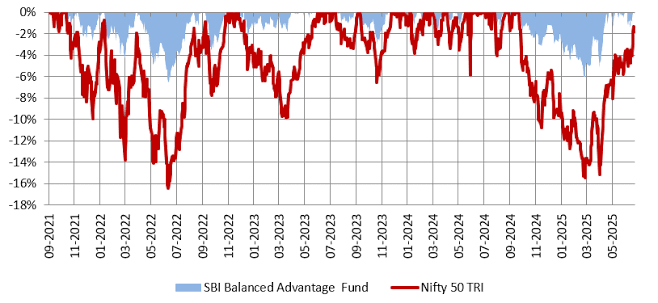
When equity markets appear expensive:
- Equity allocation may be reduced.
- Debt allocation is increased.
- Arbitrage opportunities may be used.
When markets become attractive:
- Equity allocation increases.
- Investors participate more in market recovery.
This dynamic strategy helps cushion the impact of sharp market declines compared with holding a fully equity-focused portfolio.
Asset Allocation Strategy of SBI Balanced Advantage Fund
The fund generally invests across three asset classes:
1. Equity
- Large-cap stocks
- Selected mid-cap companies
- Growth-oriented businesses
2. Debt
- Government securities
- Corporate bonds
- Money market instruments
3. Arbitrage
Arbitrage positions may be used to maintain equity taxation while reducing market risk where appropriate.
The exact allocation changes depending on market valuations and investment opportunities.
Portfolio Construction and Dynamic Investment Strategy
The investment strategy focuses on:
Valuation-Based Investing
The fund increases equity allocation when markets are reasonably valued and may reduce it when valuations appear stretched.
Diversification
Investments are spread across:
- Banking
- Financial Services
- Information Technology
- Healthcare
- FMCG
- Energy
- Manufacturing
- Infrastructure
Diversification helps reduce concentration risk.
Active Risk Management
Professional fund managers continuously monitor:
- Interest rates
- Corporate earnings
- Economic growth
- Inflation
- Market valuations
This active approach seeks to balance growth opportunities with risk management.
Why SBI Balanced Advantage Fund Stands Out Among Balanced Advantage Funds
Over different market cycles, Balanced Advantage Funds have generally demonstrated resilience during periods of volatility because of their flexible asset allocation strategy.
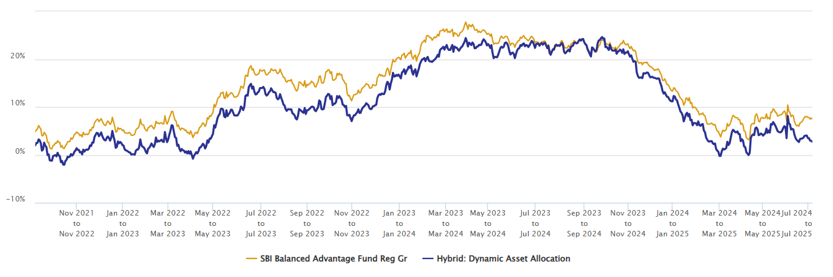
SBI Balanced Advantage Fund has built a reputation for delivering competitive risk-adjusted performance over the long term. However, past performance does not guarantee future results, and performance relative to peers can vary across different time periods.
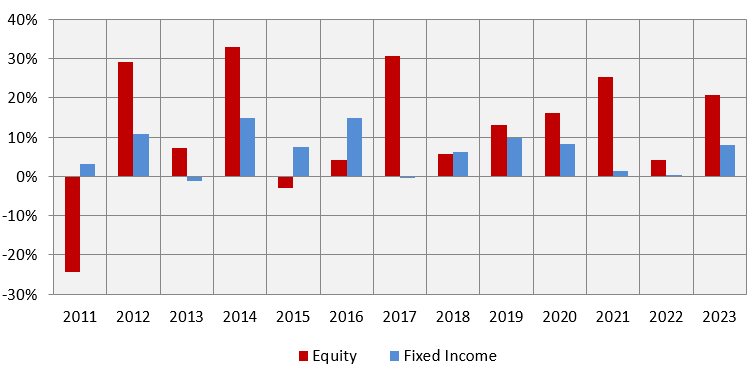
Investors should review the latest factsheet and performance data before making an investment decision.
Benefits of Investing Through SIP in SBI Balanced Advantage Fund
A mutual fund that consistently ranks in the upper quartiles indicates relatively strong performance compared with similar funds over multiple periods.
While rankings change over time, investors should look beyond short-term performance and consider factors such as:
- Consistency
- Risk-adjusted returns
- Portfolio quality
- Expense ratio
- Fund manager’s investment process
Long-term consistency is generally more important than short-term outperformance.
Can You Generate Regular Income Through SWP?
Retired investors or those seeking regular income can benefit from a Systematic Withdrawal Plan (SWP).
Benefits include:
- Monthly income
- Flexible withdrawals
- Potential tax efficiency (depending on individual circumstances and tax laws)
- Continued investment of the remaining corpus
An SWP can be particularly useful for investors who have accumulated wealth and want periodic cash flows while staying invested.
Why Invest in SBI Balanced Advantage Fund?
There are several reasons why investors choose this fund:
Automatic Asset Allocation
No need to manually switch between equity and debt.
Professional Fund Management
Experienced fund managers make allocation decisions based on research and market analysis.
Lower Volatility
Dynamic allocation aims to reduce portfolio volatility compared with pure equity funds.
Suitable for SIP
Regular SIP investments help average purchase costs across market cycles.
Diversified Portfolio
Exposure across multiple sectors and asset classes helps spread risk.
Long-Term Wealth Creation
The fund aims to balance capital appreciation with risk management over the long term.
Who Should Invest in SBI Balanced Advantage Fund?
This fund may be suitable for:
Beginner Investors
Those who are new to mutual funds and want a professionally managed, diversified portfolio.
Conservative Equity Investors
Investors who want equity exposure but are uncomfortable with the full volatility of equity funds.
Long-Term Investors
People investing for goals such as:
- Retirement
- Child’s education
- Wealth creation
- Financial independence
SIP Investors
Individuals investing monthly can benefit from disciplined investing and rupee-cost averaging.
Investors Seeking Balanced Risk
Those who want a mix of growth potential and relative stability may find this fund appealing.
Final Verdict: Is SBI Balanced Advantage Fund Worth Investing in 2026?
SBI Balanced Advantage Fund is a strong option for investors seeking a balance between growth and risk management. Its dynamic asset allocation strategy allows it to adapt to changing market conditions, making it particularly suitable for beginners and long-term investors who prefer a disciplined investment approach.
While no mutual fund can eliminate market risk or guarantee returns, SBI Balanced Advantage Fund offers a professionally managed portfolio that combines equity, debt, and arbitrage to help navigate different market environments. Investors should assess their financial goals, investment horizon, and risk tolerance before investing and review the latest scheme information and performance data regularly.
SEO Keywords: SBI Balanced Advantage Fund Review, SBI Balanced Advantage Fund 2026, SBI Balanced Advantage Fund Returns, SBI Balanced Advantage Fund SIP, Balanced Advantage Fund Review, Dynamic Asset Allocation Fund, Best SBI Mutual Fund for Beginners, SBI Balanced Advantage Fund Portfolio, SBI Balanced Advantage Fund SWP, Hybrid Mutual Fund India.
You have not enough Humanizer words left. Upgrade your Surfer plan.